
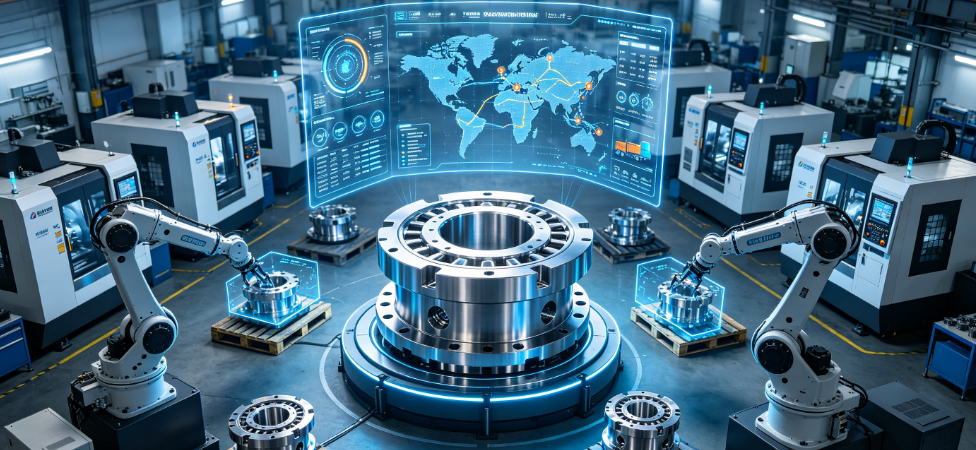
CNC Machining Is Entering a New Stage of Precision Manufacturing
CNC machining has always been an important foundation of modern manufacturing.
From aerospace components and medical devices to semiconductor equipment, robotics, new energy systems, and automotive applications, precision-machined parts are essential for industries where accuracy, reliability, and material performance are critical.
However, the role of CNC machining is changing.
In the past, machining competitiveness was often measured by production capacity and cost efficiency.
Today, manufacturers increasingly focus on:
- Micron-level precision
- Complex geometries
- Advanced materials
- Process stability
- Automated production
- Quality traceability
- Engineering capability
The global manufacturing industry is moving toward smaller tolerances, more complex structures, and higher-performance materials.
This transformation is driving continuous demand for advanced CNC equipment and high-end machining capabilities.
Growing Demand for High-End CNC Machines
The demand for CNC machines is closely connected with the development of advanced industries.
Traditional machining mainly focused on general mechanical parts.
However, emerging industries require components with much higher technical requirements.
Examples include:
Semiconductor Equipment
Semiconductor manufacturing equipment requires extremely precise components because even small dimensional errors can affect equipment performance.
Typical machined parts include:
- Aluminum precision components
- Stainless steel vacuum parts
- Structural frames
- Wafer handling components
- Precision motion parts
Aerospace
Aircraft and aerospace systems require lightweight materials such as aluminum alloys and titanium alloys.
Machining suppliers need experience with:
- Complex five-axis machining
- Material deformation control
- High precision inspection
- Process documentation
Medical Equipment
Medical devices require:
- High surface quality
- Biocompatible materials
- Strict dimensional control
- Reliable repeatability
Robotics and Automation
Robots require precision mechanical structures, including:
- Robot arms
- Joint housings
- Motor mounting parts
- Transmission components
New Energy and Automotive
Electric vehicles and energy systems are increasing demand for:
- Aluminum lightweight structures
- Battery-related components
- Motor housings
- Thermal management parts
These applications are pushing machining suppliers toward more advanced equipment and manufacturing processes.
What Defines a High-End CNC Machining Factory?
Not every CNC factory can support high-end industries.
A factory with advanced capability usually requires a combination of equipment, technology, and quality systems.
Typical high-end machining capabilities include:
Advanced CNC Equipment
Such as:
- Five-axis machining centers
- High-speed machining centers
- Precision CNC turning centers
- Automated production systems
Five-axis machining is especially important for complex aerospace, semiconductor, and robotic components because it allows multiple surfaces to be machined in fewer setups.
Advanced Inspection Capability
High-end machining requires more than machining equipment.
Quality control may include:
- Coordinate Measuring Machines (CMM)
- Optical measurement systems
- Surface roughness testing
- Material inspection
- Process monitoring
Engineering Capability
A capable machining supplier needs experience with:
- Material selection
- Tooling optimization
- Fixture design
- Machining process planning
- Tolerance control
The real competitiveness is not only the machine itself, but the ability to consistently produce qualified parts.
China and Western Countries: Different Strengths in CNC Manufacturing
The global CNC machining market is not a simple competition between regions.
Different manufacturing ecosystems have different advantages.
Europe and the United States: Technology and Process Experience
European and American machining industries have strong advantages in:
- Aerospace manufacturing
- Medical precision machining
- High-end equipment development
- Advanced machining processes
- Quality management systems
Countries such as Germany, Switzerland, and the United States have long histories in precision engineering and high-end machine tools.
Their strengths are especially visible in industries requiring extreme reliability and complex engineering validation.
China: Manufacturing Ecosystem and Supply Chain Efficiency
China has developed one of the world’s most complete manufacturing ecosystems.
Advantages include:
- Large machining capacity
- Extensive supplier networks
- Material availability
- Tooling resources
- Surface treatment capability
- Fast engineering communication
- Flexible production models
For many international customers, Chinese advantage is not simply lower cost.
It is the ability to connect multiple manufacturing processes efficiently.
A precision part may require:
CNC machining → heat treatment → surface finishing → inspection → assembly
The availability of supporting suppliers creates strong manufacturing flexibility.
How China and Western Manufacturing Can Complement Each Other
The future of global manufacturing is unlikely to be about replacing one region with another.
Instead, companies increasingly build international supply chains based on different strengths.
Western companies often provide:
- Product design
- Engineering standards
- Advanced technology
- Industry experience
Chinese suppliers often provide:
- Manufacturing execution
- Process optimization
- Supply chain coordination
- Production flexibility
This combination can create stronger global manufacturing solutions.
For international companies, the key question is not:
“Where is the cheapest machining supplier?”
The more important question is:
“Which supplier ecosystem can provide quality, reliability, flexibility, and long-term cooperation?”
Semiconductor Equipment Is Creating New Opportunities for Precision Machining
The semiconductor industry has become one of the most important drivers of precision manufacturing demand.
As global investment in semiconductor production increases, demand for semiconductor equipment and related components continues to grow.
Semiconductor equipment manufacturers require parts with:
- High dimensional accuracy
- Excellent surface finishing
- Clean manufacturing processes
- Material stability
Common materials include:
- Aluminum alloys
- Stainless steel
- Special alloys
Chinese precision machining companies are increasingly participating in this supply chain, especially in areas such as:
- Equipment structural parts
- Precision aluminum components
- Vacuum-related parts
- Mechanical modules
However, semiconductor manufacturing remains a highly demanding field.
Entering this supply chain requires not only CNC capability but also strict quality control, documentation, and understanding of semiconductor manufacturing requirements.
Southeast Asia vs China: Competition or Complement?
Countries in Southeast Asia, including Vietnam, Thailand, and Malaysia, are becoming increasingly important manufacturing locations.
Their growth is driven by:
- Global supply chain diversification
- Electronics manufacturing investment
- Automotive production expansion
Malaysia, for example, has developed strong capabilities in semiconductor packaging and electronics manufacturing.
However, high-end precision machining requires a broader industrial ecosystem.
It depends on:
- Machine tool availability
- Skilled technicians
- Material suppliers
- Tooling suppliers
- Surface treatment
- Inspection capability
Currently, China maintains a significant advantage because of its mature and interconnected manufacturing network.
However, Southeast Asia will continue to grow as part of global manufacturing diversification.
Why Supply Chain Integration Matters in Modern CNC Manufacturing
A common misunderstanding is that one machining factory should be able to manufacture everything.
In reality, different industries require different capabilities.
A supplier experienced in automotive components may not have experience with semiconductor requirements.
A factory producing general mechanical parts may not have the quality system needed for medical applications.
A five-axis machining supplier may not have the surface treatment or assembly capabilities required for a complete project.
This is why supply chain integration becomes valuable.
A professional manufacturing partner can help customers connect:
- Suitable CNC factories
- Material suppliers
- Surface treatment providers
- Inspection companies
- Assembly partners
The value is not owning every machine.
The value is knowing which manufacturing resources are suitable for each application.
The Future of CNC Machining: Precision, Specialization and Collaboration
The future of CNC machining will be shaped by three major trends:
Higher Precision
Industries such as semiconductors, aerospace, and robotics will continue demanding tighter tolerances.
Greater Specialization
Machining suppliers will increasingly focus on specific industries and materials.
Stronger Supply Chain Collaboration
Manufacturing will become less about a single factory and more about coordinated ecosystems.
Companies that can combine engineering knowledge, manufacturing resources, and supply chain management will play a more important role in global manufacturing.
Conclusion
CNC machining remains a fundamental technology supporting advanced manufacturing worldwide.
The growth of semiconductors, robotics, new energy, medical technology, and aerospace industries is creating increasing demand for precision components and advanced machining capabilities.
Western countries continue to lead in many areas of high-end engineering and manufacturing expertise, while China has developed one of the world’s most complete manufacturing ecosystems with strong supply chain coordination capabilities.
The future of precision manufacturing will not simply belong to one region.
It will belong to companies and supply chain partners that can connect the right technology, equipment, manufacturing capabilities, and global resources.