
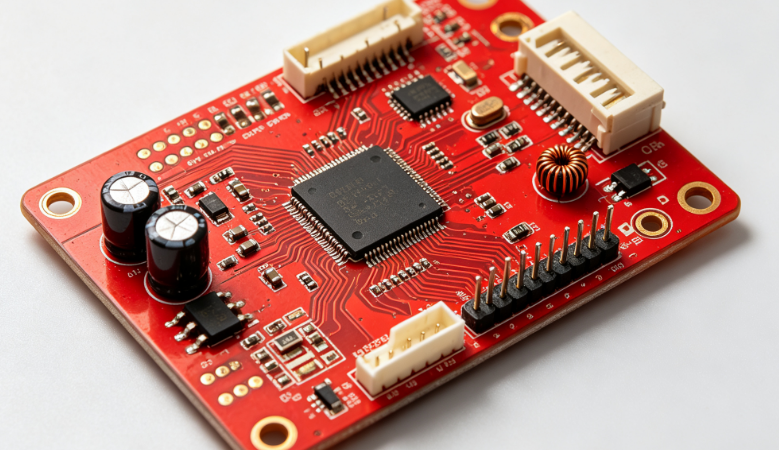
Electronic manufacturing is entering a new stage of development.
Across the global market, products are becoming smaller, smarter, more connected, and more electronically integrated. From semiconductor equipment and AI hardware to robotics, new energy systems, and automotive electronics, the demand for reliable electronic components and advanced assembly capabilities continues to grow.
Behind these products is a less visible but increasingly important part of the technology industry: the electronic manufacturing supply chain.
Components, PCB fabrication, SMT assembly, testing, and supplier coordination are becoming more closely connected. At the same time, manufacturers are looking beyond traditional sourcing models and exploring new component suppliers and manufacturing partners across different regions.
China has become an important part of this evolving global electronics ecosystem because of the depth and completeness of its electronics supply chain.
Electronic Components Are Becoming More Critical
Modern electronic products depend on a wide range of components.
Semiconductors provide computing and control functions, while connectors transmit power and signals. Switches, sensors, resistors, capacitors, inductors, and other components support the electrical and mechanical functions of the final product.
As product designs become more compact and sophisticated, the requirements for these components are also increasing.
Manufacturers are looking for components that offer:
- Stable electrical performance
- Consistent dimensions and tolerances
- Reliable materials and manufacturing processes
- Higher-density designs
- Better durability
- Stable long-term supply
- Customization for specific applications
This means electronic manufacturing is no longer simply about putting components onto a PCB.
The quality of the entire component and assembly chain can directly influence the performance and reliability of the final product.
AI, Robotics, New Energy and Automotive Electronics Are Driving Demand
The growth of emerging technologies is accelerating this development.
AI hardware requires high-performance processors, memory, power management components, high-speed interfaces, and increasingly sophisticated PCB assemblies.
Robotics requires compact control boards, connectors, sensors, motor-control electronics, and communication components.
New energy products depend heavily on power electronics, battery management systems, charging systems, connectors, and control circuits.
Automotive electronics are also becoming more complex as vehicles incorporate more electronic control, connectivity, sensing, and computing functions.
These applications are different, but they share a common requirement:
More electronic functionality requires more capable and reliable electronic manufacturing.
This is creating demand not only for advanced semiconductor devices, but also for the many supporting components and manufacturing processes that allow these devices to function as part of a complete electronic system.
SMT Is Becoming a Core Manufacturing Capability
As electronic products become smaller and component density increases, surface-mount technology (SMT) has become one of the fundamental processes in modern electronic manufacturing.
A typical SMT process may include solder paste printing, SPI inspection, component placement, reflow soldering, and AOI inspection.
The objective is not simply to place components accurately.
Manufacturers must control solder quality, placement accuracy, process stability, component traceability, and inspection results throughout production.
For more demanding products, additional processes such as X-ray inspection, ICT, FCT, manual inspection, and functional testing may also be required.
This is particularly important for products where electronic reliability is critical.
The trend is therefore moving toward more controlled and integrated manufacturing processes rather than simply higher production volume.
From PCB Assembly to Integrated Electronic Manufacturing
Another important change is the increasing integration of the manufacturing process.
In the past, a buyer might work separately with a PCB manufacturer, an electronic component distributor, an SMT factory, and a testing provider.
Today, many projects require closer coordination between these stages.
A typical electronic manufacturing project may involve:
Component sourcing → PCB fabrication → SMT assembly → DIP assembly → Inspection → Testing → Final assembly
When these processes are closely coordinated, manufacturers can better manage component availability, production schedules, quality requirements, and engineering changes.
This is particularly valuable for small and medium-volume projects, customized products, and new product development.
The ability to coordinate different suppliers can therefore become as important as the individual manufacturing process itself.
Global Electronics Manufacturing Is Becoming More Diversified
Global electronics companies are also reconsidering how they manage their supply chains.
The goal is not necessarily to move production from one country to another.
Instead, many companies are looking for a more flexible supply network with multiple qualified sources.
This can involve:
- Alternative component suppliers
- Second-source components
- Regional manufacturing partners
- Customized component development
- Localized assembly
- More flexible production capacity
For electronic components, this trend is particularly significant.
A company that has historically sourced a connector, switch, or other component from one established supplier may now evaluate alternative manufacturers to improve supply flexibility, shorten lead times, or meet specific design requirements.
This creates new opportunities for component manufacturers that can meet international quality and technical expectations.
Chinese Electronics Supply Chain Has Become Increasingly Complete
Chinese role in this global development is significant not simply because of its production scale, but because of the depth of its electronics manufacturing ecosystem.
In major manufacturing regions, different parts of the supply chain are located relatively close to each other.
These can include:
- Precision mold manufacturing
- Metal stamping
- Injection molding
- PCB fabrication
- SMT assembly
- Connector manufacturing
- Switch manufacturing
- Cable and wire assembly
- CNC machining
- Surface treatment
- Testing and inspection
- Packaging and logistics
This ecosystem creates an important advantage when customers require customization or coordination between different manufacturing processes.
For example, a customized connector may require mold development, plastic injection, metal stamping, plating, assembly, and inspection.
A PCB assembly project may involve PCB fabrication, component sourcing, SMT placement, testing, and final assembly.
Having multiple manufacturing capabilities within a connected supply chain can make these projects more efficient to coordinate.
From Component Sourcing to International Component Substitution
The development of Chinese component industry is also creating new possibilities for international buyers.
Global brands remain important in the electronics industry, particularly for applications with strict technical, certification, and reliability requirements.
However, international buyers are increasingly evaluating alternative component sources for certain applications.
This is not simply a matter of finding a cheaper replacement.
A successful component substitution normally requires evaluation of:
Electrical compatibility + mechanical compatibility + material + reliability + certification + production consistency + supply stability
For connectors, switches, terminals, and other electronic components, even small dimensional differences can affect the final assembly.
Therefore, international component substitution is becoming more closely connected with engineering evaluation and manufacturing capability.
The supplier needs to understand not only what the component is, but also how it is used.
The Competitive Advantage Is Moving Beyond Low Cost
Price remains an important consideration in electronics manufacturing, but it is no longer the only factor.
For international customers, a competitive electronic manufacturing partner increasingly needs to provide a combination of:
- Competitive manufacturing cost
- Consistent quality
- Stable component sourcing
- Engineering communication
- Flexible production
- Customization capability
- Reliable delivery
- Quality documentation
This is where the evolution of Chinese electronics supply chain becomes particularly relevant.
The advantage is not simply that products can be manufactured at competitive prices.
It is the ability to connect components, manufacturing processes, engineering resources, and logistics within one broader ecosystem.
The Future of Electronic Manufacturing
The future of electronic manufacturing will likely be defined by greater integration.
Electronic components will continue to become smaller and more application-specific.
SMT processes will become more precise and increasingly automated.
Inspection and testing will become more important as product reliability requirements increase.
At the same time, global companies will continue to diversify their component sources and manufacturing partners.
The result will be a more connected electronic manufacturing ecosystem in which component manufacturers, PCB suppliers, PCBA factories, testing providers, and supply chain partners work more closely together.
For international buyers, this creates an opportunity to build manufacturing relationships based not only on individual products, but on the capabilities of the entire supply chain.
Conclusion
Electronic manufacturing is evolving from a production-focused industry into a more integrated ecosystem connecting components, PCB manufacturing, SMT assembly, testing, engineering, and global sourcing.
The rapid development of AI, robotics, new energy, automotive electronics, and semiconductor-related products is accelerating this transformation by increasing the demand for reliable and sophisticated electronic systems.
At the same time, the increasing completeness of Chinese electronics manufacturing supply chain is creating more options for international companies seeking component sourcing, alternative suppliers, customized manufacturing, and PCBA solutions.
The future is unlikely to be defined by a simple choice between different manufacturing regions.
Instead, successful electronic manufacturing will increasingly depend on finding the right combination of components, technology, manufacturing capabilities, and supply chain partners.